


From Passive Bags to Active Players: Why the March Vault Update Changed Everything
For a long time, the crypto space has struggled with a specific problem: "Diamond Hands" vs. "Active Users." If you hold a token, you usually get the rewards. But does that build an ecosystem? Often, it just builds sellers. Since its launc
How the Wurk Vault Works (The Basics)
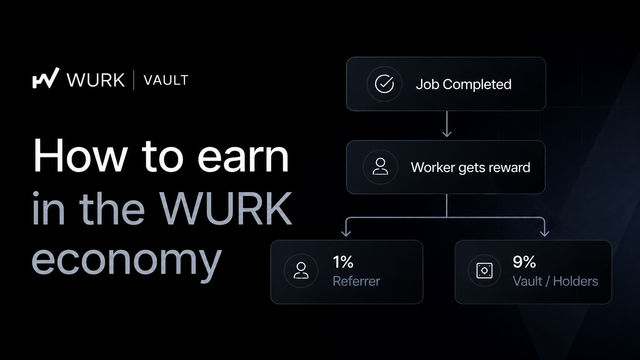
The WURK Vault is essentially a revenue-sharing pool. Every 3 hours, a portion of the platform's fees is distributed to users who meet specific criteria .
Think of it as a dividend paid by a company, but instead of just owning stock, you also have to show up to work.
The platform uses a transparent wallet system where you can track exactly how much SOL or USDC is being distributed. It isn’t a "meme coin" printing money; it is real value generated by real tasks being completed on the platform.
What Changed in March? (The "Active Filter")
Before March, the rules were simple: Hold 100k WURK, get rewards.
While this was great for whales, it led to "passive farming." People would buy the bag, mute the Telegram, and never complete a single job. This diluted the rewards for everyone because the ecosystem wasn't growing.
After the March update, the rule changed significantly . To qualify for the 3-hour distributions now, you must:
- Hold 100k+ WURK (Threshold).
- Be Active: Complete 10 jobs per week OR create 0.01 SOL worth of jobs .
Why Rewards Became Larger
If you are active, you might have noticed your SOL or USDC balance from the Vault increasing substantially after March. There is a simple mathematical reason for this: The denominator shrunk.
· Before: Rewards were split among thousands of wallets, many of which were dormant or simply holding. · After: The system automatically kicks inactive holders out of the distribution.
By removing "dead weight," the remaining active users get a much fatter slice of the pie. If you are one of the few doing the work, you are now being rewarded like a key employee, not just a silent investor.
The Ecosystem Loop (Jobs Fuel the Vault)
The genius of the Vault isn't just the distribution; it is the refill mechanism.
When you complete a job, you earn. When you post a job, you spend. But here is the kicker: The fees from those jobs go back into the Vault.
This creates a perfect flywheel:
- Builders post jobs (paying fees).
- Workers complete jobs (earning income + activity status).
- Holders (who are active) get the Vault rewards.
- Workers take those rewards and potentially stake/hold more, or post their own jobs.
This means the Vault never runs dry as long as the marketplace is moving . My Personal Analysis (Why I like this)
I’ve seen a lot of "Learn-to-Earn" and "X-to-Earn" models collapse. They usually fail because of inflation or rent-seekers.
Here is why the WURK model is different:
- It aligns incentives: If you want the high APY from the Vault, you must contribute to the marketplace. You cannot just hide in a corner.
- It creates stickiness: Once you hit that 100k threshold and start completing your 10 jobs a week, you are actively monitoring the platform. You aren't just a "number on a screen."
- Transparency: Because you can analyze the vault wallet (AGENTDQ57y57HVEsXXofZmB...), you see the history. The move to "Active Only" is visible in the on-chain data.
The March update was a wake-up call. It signaled that WURK is prioritizing utility over speculation.
Are the rewards larger? Yes—for those who work. Is the ecosystem healthier? Absolutely. We are moving away from a culture of "hodl and dump" to a culture of "build and earn."
If you have 100k WURK but haven't done your 10 jobs this week, you are leaving money on the table. Go check the Vault tab, get active, and watch your rewards grow.





Latest comments
0