


THE FUTURE OF WORK IS ACTIVE: INSIDE THE WURK VAULT ECOSYSTEM
FROM MICROTASKS TO ECOSYSTEM POWER: HOW THE WURK VAULT TURNS ACTIVITY INTO REWARDS The internet is slowly shifting away from passive participation. For years, most platforms rewarded people simply for holding assets, staying early, or farmi
FROM MICROTASKS TO ECOSYSTEM POWER: HOW THE WURK VAULT TURNS ACTIVITY INTO REWARDS
The internet is slowly shifting away from passive participation. For years, most platforms rewarded people simply for holding assets, staying early, or farming systems without contributing real value. But recently, a different model has started gaining attention — ecosystems where activity itself becomes the engine of rewards.
That’s one of the reasons the [WURK platform]caught my attention.
As someone active in the creative and freelance space, I originally approached WURK from the angle most users do: completing social tasks, reposting on X, engaging with campaigns, and participating in creator-focused microjobs. But after spending time inside the ecosystem, one thing became obvious very quickly:
WURK is not just a task platform. It is trying to build a circular economy around contribution.
And the center of that system is the Vault.
WHAT THE WURK VAULT ACTUALLY IS
The [WURK Vault]: is essentially a reward distribution system connected directly to ecosystem activity.
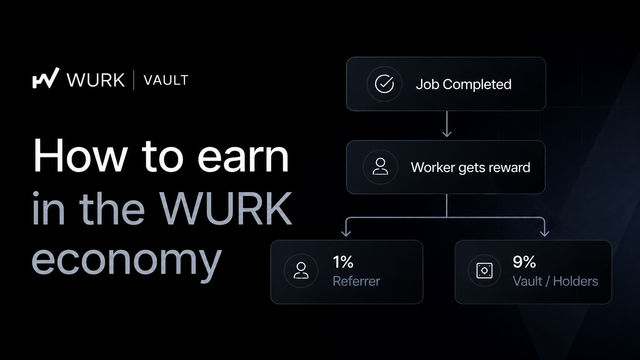
Instead of rewards appearing from nowhere, the vault is continuously fueled by platform usage itself. Every completed task, campaign activity, and user interaction contributes toward keeping the ecosystem alive and circulating.
This creates something interesting:
Users complete jobs
Platform activity generates ecosystem value
Part of that value flows back into the vault
Active holders receive rewards
Those rewards encourage even more participation
Rather than separating workers, holders, and builders into different groups, WURK connects them into one loop.
That design choice matters more than people realize.
HOW THE VAULT REWARD SYSTEM WORKS
The vault system currently rewards users who:
Hold at least 100k WURK
AND remain active on the platform
That second condition is the important part.
Before March, rewards were distributed to all holders with 100k+ WURK regardless of whether they actually participated in the ecosystem or not.
After the March update, the model changed completely.
Now, rewards go specifically toward active ecosystem participants.
That means users who:
complete jobs,
interact with campaigns,
contribute to platform activity,
and remain engaged,
are prioritized over passive holders simply sitting on tokens.
From an ecosystem perspective, this was a major shift.
WHY THE MARCH UPDATE CHANGED EVERYTHING
The March update quietly solved one of the biggest problems many crypto ecosystems face: passive extraction.
In older systems, people could simply buy tokens, disappear, and continue collecting rewards without contributing anything meaningful back into the platform. Over time, this weakens ecosystems because rewards become diluted across inactive wallets.
WURK’s newer system reduced that issue significantly.
By moving rewards toward active users only, the vault became more concentrated.
And because fewer inactive wallets were sharing distributions, active users reportedly started receiving noticeably larger rewards after the update.
This is where the model becomes genuinely interesting.
The system now behaves less like passive staking and more like an activity-powered economy.
The rewards are no longer disconnected from contribution.
They are tied directly to participation.
HOW COMPLETED JOBS HELP REFILL THE VAULT
This is probably the most important part of the entire ecosystem.
Most reward systems eventually run into sustainability problems because tokens leave the system faster than value enters it.
WURK attempts to address that by linking vault growth to actual platform activity.
Every time:
campaigns are launched,
social tasks are completed,
creators engage with promotions,
freelancers interact with jobs,
or ecosystem usage increases,
the overall economic movement inside the platform strengthens the vault structure over time.
In simple terms:
Activity feeds the vault.
That creates a feedback loop where ecosystem growth and vault rewards become connected instead of isolated.
As a freelancer and artist, I personally find this model more realistic than systems that rely purely on hype cycles. The more useful the platform becomes, the stronger the reward engine potentially becomes alongside it.
WHY THIS MODEL FEELS DIFFERENT AS A CREATOR
A lot of platforms say they “reward community,” but many times the actual contributors are not the ones benefiting the most.
What stood out to me with WURK is how closely the system tries to align effort with reward.
As someone who actively completes social tasks across X, Instagram, and even creator-related tools like Sora campaigns, the ecosystem feels designed around visible participation.
The experience feels straightforward:
you contribute,
you stay active,
and the system reflects that activity.
That may sound simple, but simplicity is important.
A reward model becomes stronger when users clearly understand:
“My effort affects my outcome.”
That transparency is part of what makes the ecosystem feel more user-focused compared to platforms where rewards feel random or disconnected from contribution.
VAULT ANALYTICS, TRANSPARENCY, AND TRUST
Another underrated aspect of the WURK ecosystem is transparency.
The vault interface allows users to explore wallet histories, reward charts, and distribution activity publicly. That visibility matters because users can actually observe how the system behaves over time instead of blindly trusting promises.
One wallet often referenced inside the ecosystem started with exactly 100k WURK Tracking wallets like this gives users a better understanding of:
reward consistency,
vault growth trends,
distribution behavior,
and post-March reward concentration.
While exact APY fluctuates depending on platform activity and participation levels, the noticeable increase in active-user rewards after March suggests the ecosystem became significantly more efficient once inactive farming was reduced.
And honestly, that makes sense mathematically.
If the reward pool remains healthy while fewer inactive wallets are sharing it, active participants naturally receive larger portions.
WHY ACTIVITY-BASED REWARD SYSTEMS MAY SCALE BETTER
One thing I keep thinking about is how internet platforms are evolving.
Older models rewarded attention.
Newer ecosystems are starting to reward participation.
That difference is huge.
WURK’s vault system creates an environment where:
creators,
freelancers,
marketers,
holders,
and platform users all benefit from the same growth cycle.
If more jobs appear: → platform activity increases.
If activity increases: → vault circulation potentially strengthens.
If vault rewards strengthen: → users become more incentivized to stay active.
That loop creates alignment between ecosystem growth and user motivation.
From a long-term perspective, that feels healthier than systems where rewards are disconnected from real platform usage.
MY FINAL THOUGHTS
The most interesting thing about WURK is not just the vault rewards themselves.
It is the structure behind them.
The platform is experimenting with a model where contribution matters more than passive presence, and where ecosystem activity directly influences reward strength.
As an artist and freelancer, that idea stands out to me because it mirrors how real creative work functions in everyday life:
effort compounds,
visibility compounds,
participation compounds.
The recent March update especially made the ecosystem feel more intentional. Instead of rewarding inactivity, the platform shifted toward rewarding users who actually help move the ecosystem forward. And in a digital economy increasingly filled with automated farming and passive extraction, that shift may end up being one of the smartest parts of the WURK model. If WURK continues improving platform activity, transparency, and ecosystem utility at the pace it currently is, the vault system could become one of the more interesting examples of activity-driven reward mechanics in creator and microjob ecosystems.




Latest comments
0