

The Wurk Vault: How Activity-Powered Rewards Are Redefining Token Distribution
Introduction In the world of crypto tokens, "passive income" has become one of the most abused promises in the space. Countless projects have launched with grand visions of rewarding holders, only to collapse under the weight of unsustaina
The Wurk Vault: How Activity-Powered Rewards Are Redefining Token Distribution
Introduction
In the world of crypto tokens, "passive income" has become one of the most abused promises in the space. Countless projects have launched with grand visions of rewarding holders, only to collapse under the weight of unsustainable tokenomics and mercenary capital that farms rewards and immediately dumps.
But what if there was a better model? What if token rewards could actually align the interests of holders, builders, and active platform participants—creating a self-reinforcing ecosystem that grows stronger as it scales?
Enter the Wurk Vault—a revenue-sharing mechanism that doesn't just reward holding, but rewards participation. In this deep dive, I'll explore how the Wurk Vault works, why the March 2026 update fundamentally changed the reward dynamics, and why I believe this model represents a fascinating evolution in sustainable token distribution.
What Is the Wurk Vault?
At its core, the Wurk Vault is a revenue-sharing pool that distributes platform earnings back to $WURK token holders. But unlike traditional staking models or yield farms, the Vault's funding comes directly from real platform activity—not from token inflation or complex DeFi mechanics.
How the Vault Gets Funded
Every microjob completed on Wurk contributes to the Vault:
Platform Fee Structure:
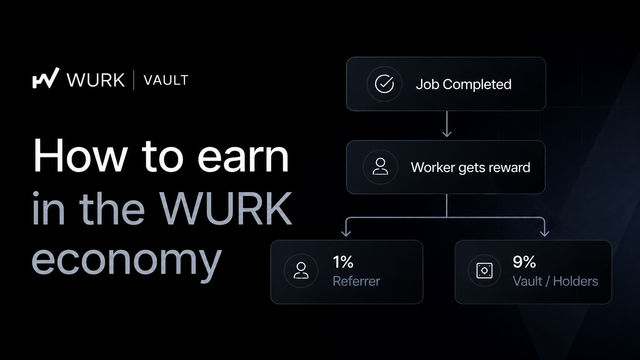
10% platform fee on all repost jobs
If a job is referred: 1% goes to referrer, 9% goes to Vault
If not referred: full 10% goes to Vault
Example: A creator posts a repost job worth 1 SOL. The platform takes 0.1 SOL as a fee. That 0.1 SOL flows directly into the Vault, accumulating alongside fees from thousands of other microjobs happening daily.
The Distribution Mechanism
Every 3 hours, the following happens automatically:
Collection: All accumulated SOL fees in the Vault are tallied
Swap: The SOL is swapped into $WURK tokens on the open market
Distribution: $WURK tokens are sent proportionally to eligible holders
The distribution wallet uses the domain wurk.sol, making it easily identifiable on Solana block explorers. Every distribution is fully transparent and verifiable on-chain.
Key numbers:
Approximately 9% of platform revenue is distributed to holders
Over 11.7 million $WURK distributed since launch (as of October 2025)
Distributions happen 8 times per day, every 3 hours
The March 2026 Update: From Passive to Active Rewards
The Original Model (Pre-March 2026)
For the first six months of operation, Wurk used a simple eligibility criteria:
Eligibility:
Hold at least 100,000 $WURK tokens
That's it. No activity requirements. No participation thresholds. Just hold and earn.
The problem: This created a classic passive farming dynamic. Large holders could simply buy 100k+ tokens and collect rewards without ever using the platform. While this attracted capital, it didn't necessarily attract users—the people actually creating the value that funded the Vault in the first place.
The New Model (Post-March 2026)
In late March 2026, Wurk introduced a fundamental shift:
New Eligibility Requirements:
Hold at least 100,000 $WURK tokens, AND
Meet ONE of these activity criteria:
Created at least 0.01 SOL worth of jobs in the last 7 days, OR
Completed at least 10 jobs in the last 7 days
The rationale, from Wurk's announcement:
"It's time to change that and reward the holders that are active in the WURK ecosystem."
This wasn't just a minor tweak—it was a philosophical shift from "rewarding capital" to "rewarding active participation."
Why This Change Matters: Analyzing the Impact
- Concentrated Rewards for Active Participants
By requiring activity, the number of eligible wallets decreased significantly. This means the same pool of rewards is now split among fewer recipients—dramatically increasing per-wallet earnings for active users.
Before March:
Any wallet with 100k+ $WURK received distributions
Passive farmers with no platform usage diluted rewards
Active users earned the same as passive holders
After March:
Only active 100k+ holders receive distributions
Fewer eligible wallets = higher rewards per active participant
Passive farmers are filtered out
- Alignment of Incentives
The new model creates a virtuous cycle:
Active users create/complete jobs ↓ More platform activity = more fees ↓ Vault grows larger ↓ Active holders earn more rewards ↓ Incentive to stay active increases
This aligns the interests of:
Builders (job creators): They fund the platform, earn rewards for creating jobs
Wurkers (job completers): They complete tasks, earn rewards for participation
Holders: They can still earn, but only if they contribute to ecosystem activity
- Reduced Dump Pressure
Passive farming creates predictable sell pressure. Farmers accumulate rewards and systematically dump them without any connection to the project's long-term success.
With activity requirements:
Holders must engage with the platform to stay eligible
Engagement creates familiarity and (potentially) genuine belief in the ecosystem
Active participants are more likely to compound or hold rather than immediately sell
- Quality Over Quantity
The shift prioritizes quality holders over quantity of holders.
Would you rather have:
1,000 passive wallets farming rewards and dumping, or
200 active wallets that actually use the platform, create jobs, complete tasks, and contribute to growth?
The March update chose the latter—and it's a choice that prioritizes sustainable ecosystem health over short-term holder count metrics.
The Ecosystem Effect: How Everything Connects
What makes the Wurk Vault particularly elegant is how it creates interconnections between all platform participants:
For Builders (Job Creators)
Pay fees to post jobs → Fees flow to Vault
By posting jobs, they become eligible for Vault rewards
Their activity funds the very rewards they receive
Net effect: Lower effective cost of using the platform (fees offset by rewards)
For Wurkers (Job Completers)
Complete jobs to earn SOL/$WURK directly
By completing jobs, they become eligible for Vault rewards
Two revenue streams: immediate task payments + Vault distributions
Net effect: Higher overall earnings for active participants
For the Platform
More activity = more fees = larger Vault distributions
Larger rewards attract more users to hold $WURK
More holders (with activity requirements) = more platform usage
Net effect: Self-reinforcing growth loop
For the Ecosystem
Real value creation (microjobs) funds rewards (not token inflation)
Transparent on-chain distribution builds trust
Activity requirements filter out mercenary capital
Net effect: Sustainable tokenomics tied to actual platform utility
Transparency: Trust Through Verification
One of the most impressive aspects of the Wurk Vault is its radical transparency. Everything is verifiable on-chain:
What you can track:
Every fee collected and added to the Vault
Every SOL → $WURK swap before distribution
Every distribution to eligible wallets
Historical earnings for any wallet address
Tools available:
Vault dashboard at wurk.fun/vault
Distribution history with timestamps
Wallet-specific analytics (enter any address to see their earnings history)
The distribution wallet (wurk.sol) can be monitored on any Solana explorer
This level of transparency is rare in crypto. Most projects obscure their reward mechanics or make verification difficult. Wurk does the opposite—every number is publicly auditable.
Analyzing the Numbers: What Do Rewards Actually Look Like?
While exact APY fluctuates based on platform volume and eligible holders, the post-March update has significantly improved rewards for active participants. Here's why:
Mathematical Reality:
Same Vault pool (funded by platform fees)
Fewer eligible wallets (activity requirement filters out passive holders)
Higher per-wallet distribution
Example Scenario: Imagine the Vault accumulates 10 SOL in a 3-hour window:
If 100 wallets are eligible: each gets ~0.1 SOL worth of $WURK
If only 50 wallets are active-eligible: each gets ~0.2 SOL worth of $WURK
By requiring activity, Wurk has effectively doubled the reward density for genuine participants.
For the recommended tracking wallet (AGENTDQ57y57HVEsXXofZmBxUc8RQWKH7DwXRLYeVQHY):
Started with exactly 100k $WURK (minimum threshold)
You can monitor this wallet's earnings history to see the impact of the March update
Post-March charts likely show increased distribution amounts per cycle
Personal Analysis: Why I Find This Model Compelling
Having studied numerous token distribution models across DeFi and Web3, the Wurk Vault stands out for several reasons:
- Real Revenue, Not Inflation
Most "passive income" tokens pay rewards by minting new tokens—inherently diluting holders. Wurk pays rewards from actual platform revenue. This is the difference between a sustainable business model and a Ponzi-like structure.
- Activity as Proof of Value
Requiring activity is brilliant because it forces holders to actually understand the product they're investing in. You can't farm Wurk rewards without engaging with the platform—and engagement builds genuine conviction (or filters out those who don't believe).
- Flywheel Potential
As more users join and create/complete jobs, the Vault grows. Larger Vaults attract more holders. More holders (who must be active) means more platform usage. This creates a compounding growth loop that benefits everyone participating.
- Transparent Trust
In an industry plagued by rug pulls and hidden mechanics, Wurk's on-chain transparency is refreshing. Every claim can be verified. Every distribution is traceable. This builds trust that attracts serious participants.
- Sustainable Incentives
By tying rewards to real activity, Wurk has created a model that could theoretically run indefinitely—as long as the platform has users completing jobs. There's no inflationary cliff to worry about, no unsustainable APY promises that will collapse.
Potential Risks and Considerations
No model is perfect, and it's important to consider potential challenges:
- Activity Requirements May Exclude Some Holders
Not everyone has time to complete 10 jobs/week
This could concentrate rewards among power users
However, this may be a feature, not a bug—it prioritizes genuine participants
- Platform Dependency
Vault rewards depend entirely on platform volume
If Wurk usage declines, so do rewards
But this is true of any real-revenue model—transparency about this is healthier than false promises
- Barrier to Entry
100k $WURK is a significant investment for smaller users
Activity requirements add another layer
But for serious participants, these barriers may filter out noise and attract quality
- Regulatory Uncertainty
Revenue-sharing tokens face regulatory scrutiny in some jurisdictions
Wurk's model is innovative, but regulatory clarity is evolving
The Bigger Picture: What Other Projects Can Learn
The Wurk Vault model offers lessons for the broader crypto space:
Lesson 1: Stop Rewarding Passive Capital Passive farming attracts mercenaries, not believers. Activity requirements build real communities.
Lesson 2: Fund Rewards from Revenue Token inflation is not a sustainable reward mechanism. Real revenue creates real sustainability.
Lesson 3: Be Radically Transparent If your distribution mechanism is sound, you should want people to verify it. Obscurity breeds distrust.
Lesson 4: Align All Stakeholders Builders, users, and holders should all benefit from the same growth loop. When incentives align, flywheels emerge.
Conclusion: A Model Worth Studying
The Wurk Vault represents a thoughtful evolution in token distribution mechanics. By shifting from passive holding rewards to active participation rewards, Wurk has created a system where:
Real platform activity funds the Vault
Active participants earn concentrated rewards
Incentives align across all ecosystem participants
Transparency enables trust and verification
The March 2026 update wasn't just a change in eligibility rules—it was a philosophical statement about what kind of community Wurk wants to build: one where contributors are rewarded, not just capital allocators.
For anyone interested in sustainable tokenomics, the Wurk Vault is a case study worth following. As the platform grows and the ecosystem evolves, I'll be watching closely to see if this model delivers on its promise: a self-sustaining flywheel where everyone who contributes benefits.
Explore the Vault yourself:
Track distributions: wurk.fun/vault
Read the FAQ: wurk.fun/faq
Join the community: Telegram
Follow updates: @WURKDOTFUN
$WURK Contract Address: ALR5X2H6THn2VDPoMtkVwxVktcN1kQGvxCwLfejzpump
This blog represents my personal analysis and is not financial advice. Always do your own research before investing.





Latest comments
0