

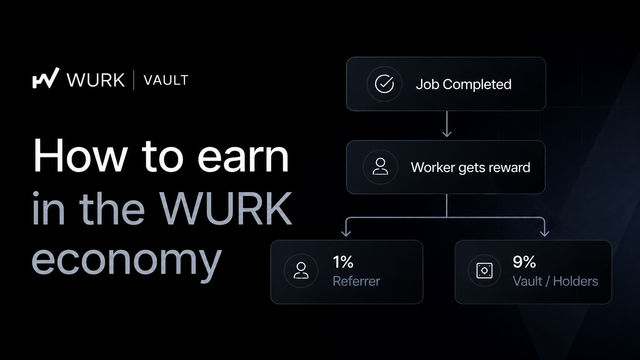
When I first looked at Wurk, the thing that caught my attention was not only the microjob marketplace, but also the way the Wurk Vault connects platform activity with token holders.
A lot of crypto projects talk about rewards, but many of them are just passive systems where people hold a token, wait, and farm rewards without really doing anything for the ecosystem.
Wurk feels a bit different because the Vault is connected to activity. The platform is built around jobs, users, creators, builders, and holders all moving inside the same ecosystem. That makes the Wurk Vault more interesting than a normal reward pool.
What the Wurk Vault Means
The Wurk Vault is basically the reward mechanism for eligible WURK holders. To qualify, a holder needs at least 100,000 WURK. But after the March update, holding alone is no longer enough. The user also needs to be active on the Wurk platform.
This change is important because it changed the whole meaning of the reward system.
Before March, Vault rewards were distributed to all holders with at least 100k WURK. That system was simple, but it also allowed passive farming. A wallet could hold enough WURK, do nothing on the platform, and still receive rewards.
After March, the system became more focused. Vault rewards are now distributed only to holders with 100k+ WURK who are also active on the platform. This means the reward system moved from rewarding all holders to rewarding active holders only.
In my opinion, this is a healthier direction.
Why Activity Matters
The reason is simple: a platform becomes stronger when people actually use it.
If users only hold tokens and wait for rewards, the ecosystem may look active from the outside, but the real platform activity can still be weak. But if holders are encouraged to complete jobs, interact with the platform, and support creators, then the rewards are connected to real participation.
That is where the Wurk Vault becomes interesting.
Wurk is a microjob marketplace. Creators or builders can create jobs, and users can complete them. These jobs can be social tasks, writing tasks, feedback, testing, or other small actions. When more jobs are created and completed, the platform becomes more useful.
This creates a simple cycle:
- Creators post jobs
- Users complete jobs
- Platform activity grows
- The Vault is supported by ecosystem activity
- Active eligible holders receive rewards
- Those users have more reason to stay active
This cycle is much better than a system where rewards are only distributed to passive holders. In Wurk, the Vault creates a connection between platform growth and holder rewards.
How Completed Jobs Help the Vault
Completed jobs are important because they show that the platform is being used.
Every job completed is a sign that someone needed work done and someone else provided that work. That may sound simple, but in a microjob platform, this is the core of the economy.
If more builders use Wurk to promote projects, get feedback, test ideas, or create campaigns, then more users have reasons to participate. If more users participate, the platform becomes more attractive for future creators. Over time, this kind of activity can help refill and grow the Vault.
This is why I think the Vault is not just about rewards. It is also about behavior.
What Changed After March
The March update made this even clearer.
Before the update, rewards were spread to every holder with 100k WURK or more. After the update, passive holders were removed from the reward group if they were not active.
Because of that, rewards became more concentrated toward active users. When fewer passive wallets receive rewards, the active participants can receive a larger share. This is one reason why rewards became bigger after the March update.
For example, if a reward pool is divided between many holders, each person gets a smaller amount. But if the same reward pool is only shared with users who are active and eligible, the reward per active user can become much larger.
That is exactly why the March update matters. It did not only change who receives rewards. It changed the incentive of the whole ecosystem.
Instead of saying “just hold WURK,” the system now says “hold WURK and participate.”
I think this is a better message for long-term growth.
Why Active Holders Are Better Than Passive Farmers
Rewarding active users can create a stronger ecosystem because active users bring value back to the platform.
They complete jobs, support campaigns, help builders, and create real usage. Passive holders may support the token, but they do not always support the product.
A healthy Web3 platform needs both holders and users. Wurk is trying to combine them into one group: active holders.
That is what makes the model interesting to me.
Builders benefit because they can get jobs completed.
Workers benefit because they can earn from microtasks.
Holders benefit because the Vault rewards active participation.
The platform benefits because activity keeps growing.
Everyone is connected through the same system.
My Personal Take
Of course, this model still depends on real platform growth. If there are more jobs, more users, and more activity, the Vault becomes more meaningful. If activity slows down, rewards may also change.
But I actually think that makes the system more honest. Rewards should be connected to usage, not only hype.
A reward system that pays everyone forever without activity is usually not sustainable. But a reward system that rewards people who help grow the platform has a better chance of lasting longer.
For me, the Wurk Vault is interesting because it turns holding into participation. It gives users a reason to care about the platform, not just the token price. It also reduces passive farming, which can make the ecosystem healthier.
The March update was a big step in that direction. By moving from rewarding all 100k+ holders to rewarding only active 100k+ holders, Wurk made the reward system more focused, more fair, and more connected to real contribution.
Final Thoughts
In the end, I think the Wurk Vault is not just a reward feature. It is one of the main parts of the Wurk ecosystem. It connects microjobs, platform activity, holders, and rewards into one loop.
If Wurk continues to grow and more people use the platform for real jobs, the Vault can become a strong reason for users to stay active.
And in crypto, that is important, because the strongest ecosystems are usually not the ones with the most passive farmers, but the ones with the most real users.





Latest comments
0